Press Kit
Quick Facts
The Name
Apache OpenOffice™The Community
Registered Members: >750,000Developers: >100 FTE
Committers: > 500
The Software
Version: 3.4Downloads: >40m
Applications: 6
Platforms: 8
Languages: 28
Development: >20 yrs elapsed
Size: >10,000 kloc
Licence: OSI approved
File format: ISO approved
Licensing
Source Code: Apache License 2.0Major Contributors
Sun MicrosystemsOracle
Novell, Inc.
Beijing Redflag CH2000
Red Hat, Inc.
IBM Corp.
Google Inc.
Quick Links
Product InformationLicensing
Logo
Screenshots
FAQ
Key facts and figures about Apache OpenOffice for the media.
Naming
- Name - we are Apache OpenOffice™ (not Open Office or OpenOffice).
- Apache OpenOffice is both the name of a software product and the name of the open-source project which designs, develops, maintains, translates, tests, documents, supports, and promotes the software.
- Note: Prior to version 3.4.0 the product was referred to as OpenOffice.org® and that term may still proper when referring to these older releases.
Key points about the Apache OpenOffice Productivity Suite.
-
Apache OpenOffice provides everything most people need in an office
productivity suite. The main components of Apache OpenOffice
are:
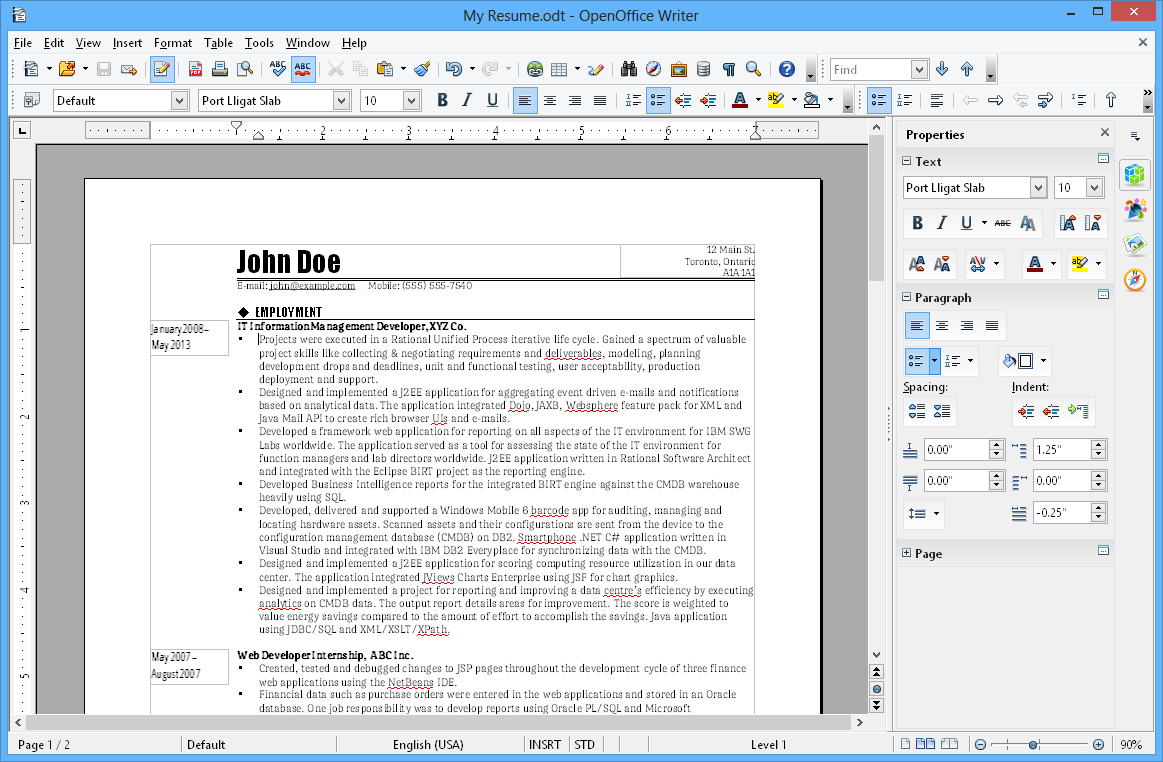
- Writer, a wordprocessor (screenshot)
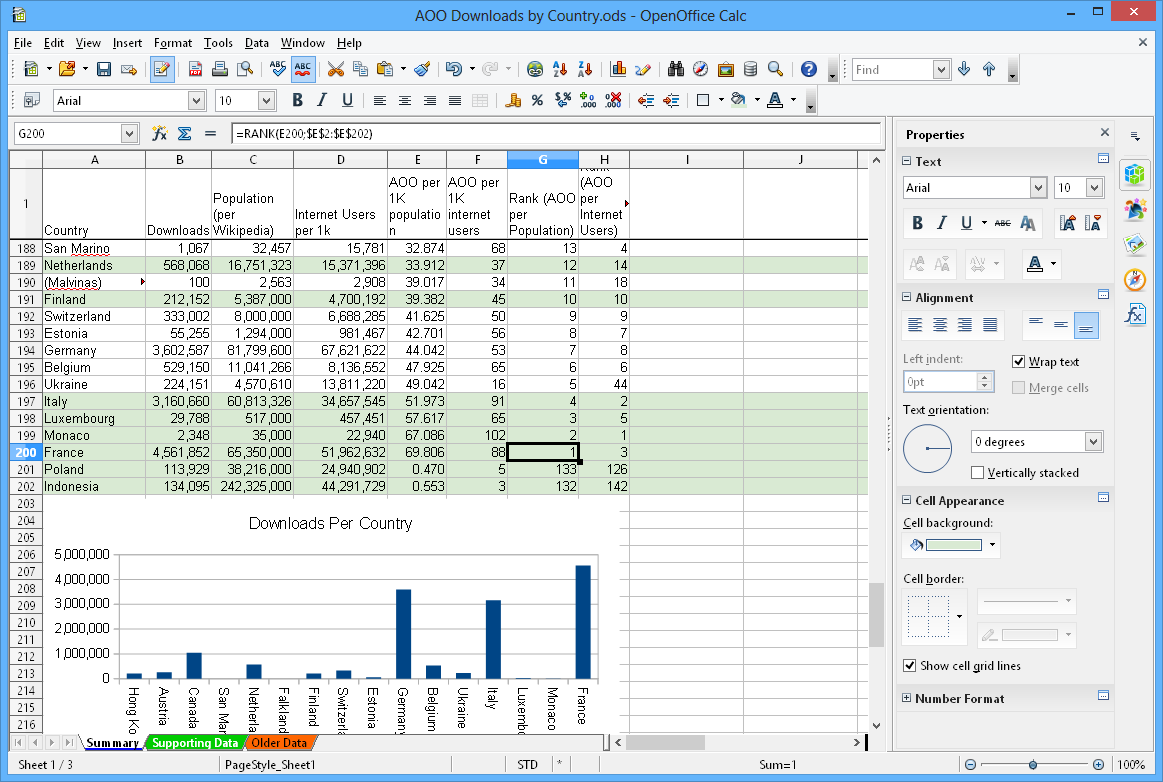
- Calc, a spreadsheet (screenshot)
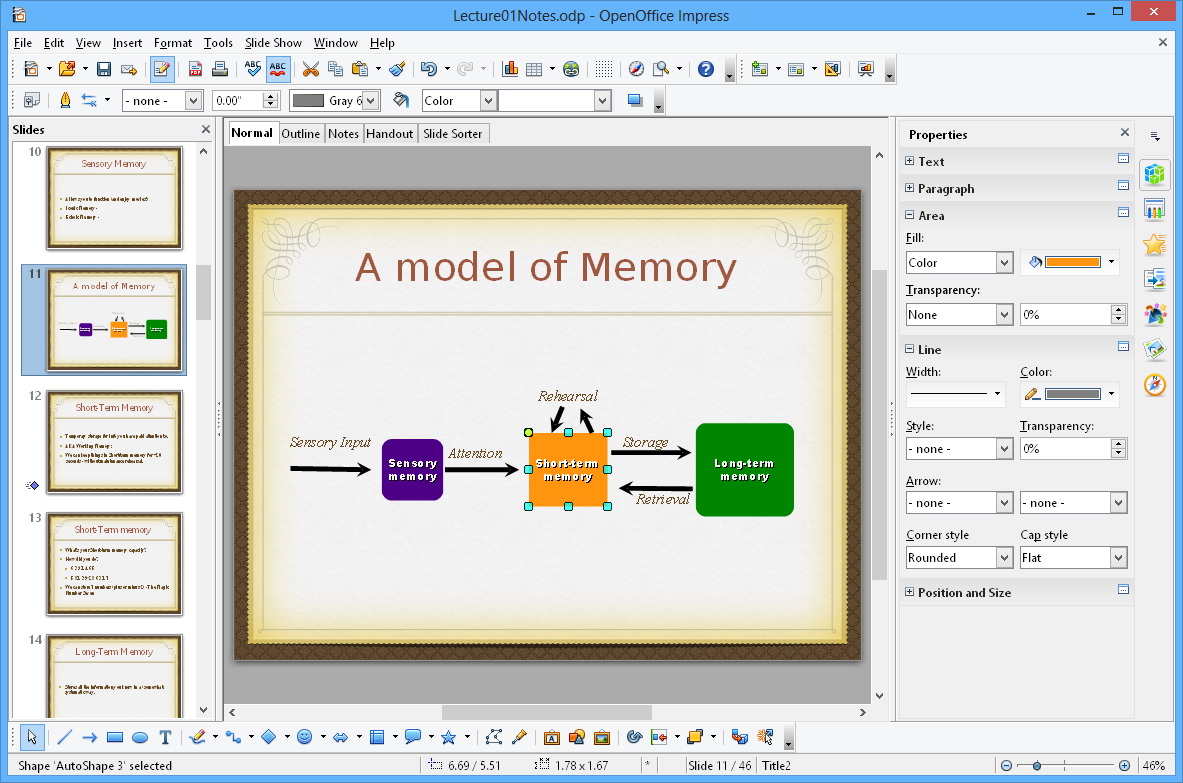
- Impress a presentation editor (screenshot)
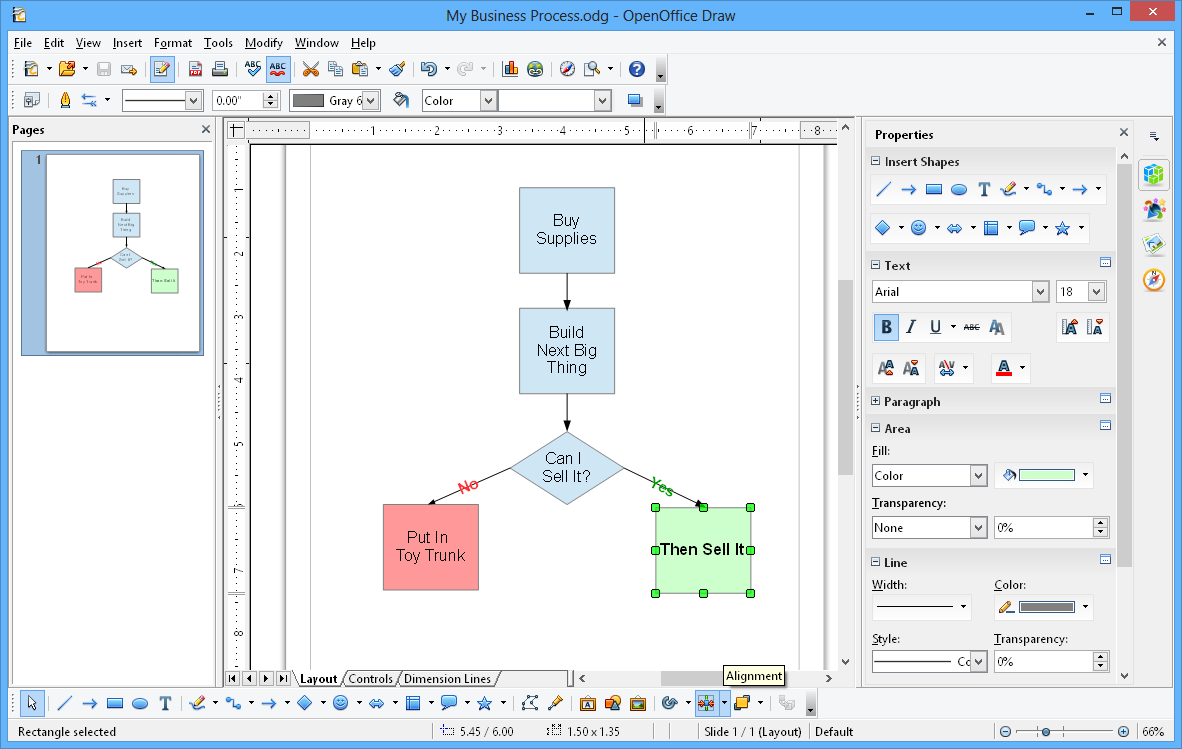
- Draw a vector graphics editor (screenshot)
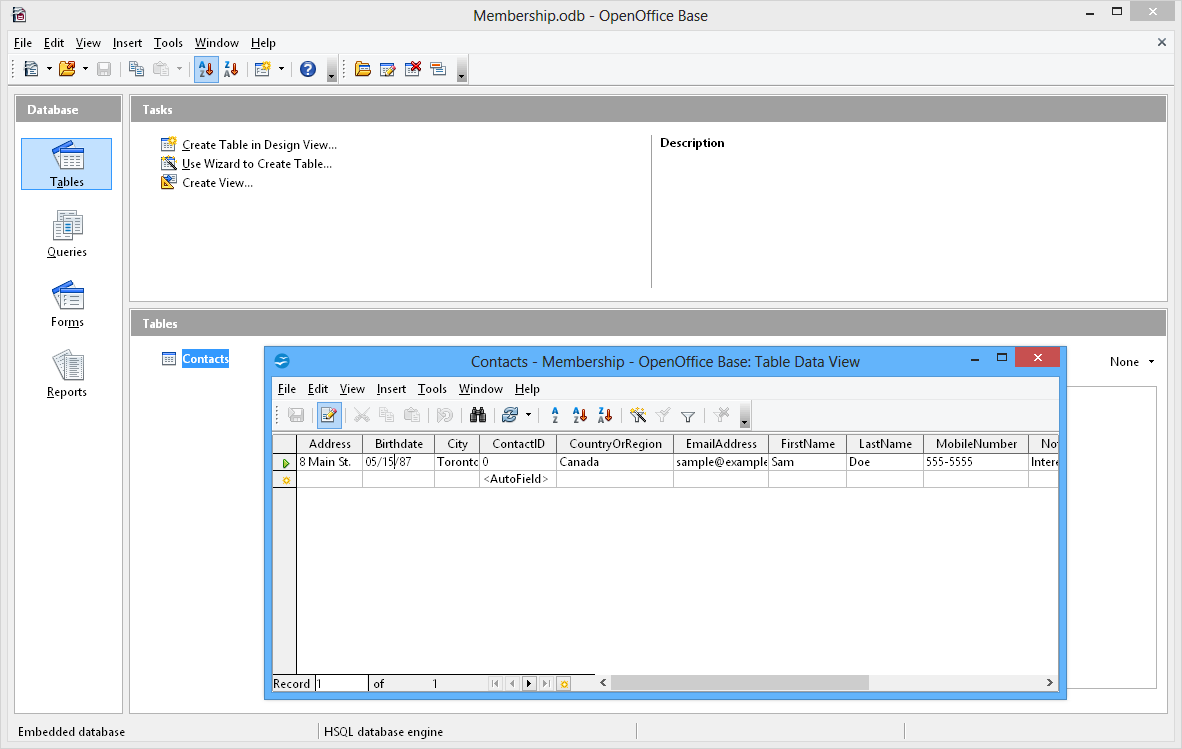
- Base database front-end (screenshot)
- Apache OpenOffice is both easy to use and easy to migrate to, for both experienced and beginners alike. It has a familiar user interface, and is able to read and write the vast majority of legacy file formats (including common Microsoft Office formats). It is supported in nearly 30 languages, with active support, both community based (free) and from commercial organisations (paid-for).
- Apache OpenOffice is released under an open-source licence (Apache License 2.0), which means it may be used free of any licence fees, for any purpose: private, governmental, commercial, etc. Once acquired it may be installed on an unlimited number of computers, and may be copied and distributed without restriction. Apache OpenOffice supports extensions, allowing users to add on extra functions easily from an extensions repository. This is a key differentiator from the competition.
Apache OpenOffice is available on all major computing platforms and is supported in nearlt thirty languages. Our best estimate is that Apache OpenOffice currently enjoys over 15% market share for office productivity suites.
Key points about the Apache OpenOffice Community
Apache OpenOffice is a project of the Apache Software Foundation, a US-based non-profit organization dedicated to publishing free software for the public good.
The overwhelming majority of Community members are volunteers. A small number are sponsored by their employers to work on Apache OpenOffice. Most of these work in software development.
Concise history of Apache OpenOffice
Apache OpenOffice is a mature software product, tracing its origins back over twenty years to a commercial software house in Germany, StarDivision. Following the acquisition of StarDivision by Sun Microsystems in April 1999, OpenOffice.org version 1.0 was released as open-source software on May 1st 2002. It proved hugely successful, and after more than 49 million recorded downloads, version 2.0 was released on 20th October 2005. OpenOffice.org 2 removed the last barriers to migration with a new user interface, improved support for competitors' file formats, and a new integrated database component. It also became the first office suite to support the new Open Document Format for office applications (ODF) natively. OpenOffice.org 3 was announced on October 13, 2008, and recorded 100 million downloads by October 28, 2009. Oracle acquired Sun Microsystems in 2010. In June 2011 Oracle contributed the source code and trademarks to the Apache Software Foundation, enabling the OpenOffice.org community to achieve their dream of having OpenOffice maintained as a community-run open source project at an independent foundation. In 2012 the project voted to rename itself to Apache OpenOffice.
Logos, etc
Logos may be found here
Press Releases
We keep an on-line archive of press releases.
We also have a low volume announcements mailing list; you can browse an archive of these announcements, or subscribe to the list by sending a blank email to announce-subscribe@openoffice.apache.org.
Press Contacts
Press inquires should be sent to press@openoffice.apache.org.